Globalist University for Organizations
Extend development beyond the moments when formal support takes place.
Globalist University gives participants a structured environment for continuing to learn, reflect, take action, and build momentum between classes, counseling sessions, coaching conversations, case-management meetings, and other program touchpoints.
Support happens in moments. Development happens over time.
Organizations already provide valuable guidance, relationships, instruction, and support. The challenge is maintaining direction and momentum between those moments and after structured programs end.
Globalist University provides a connected learning environment where participants can continue developing independently while remaining aligned with the goals of the program supporting them.
How development continues between touchpoints
How development continues between touchpoints.
Human support is powerful, but often intermittent. Globalist University gives participants a structured way to keep learning, reflecting, and taking action between formal program moments—while helping staff maintain greater visibility into engagement and progress.
The operating model has two connected systems. First, the organizational support lane includes five formal touchpoints: Intake and Orientation, Staff Check-in, Coaching or Counseling, Progress Conversation, and Next-Step Planning. Between each of these formal moments, Globalist University provides a repeating development loop: Choose a focus, Learn, Reflect, Take action, Record progress, Continue.
Participants
Clearer next steps, guided reflection, and practical action between formal program moments.
Staff
A stronger basis for conversations about engagement, barriers, progress, and what should happen next.
Organizations
A structured way to extend development without adding a heavy administrative burden.
Globalist University complements the support organizations already provide. The goal is not more programming. It is greater continuity.
See a representative six-week pathwayThe participant experience
A structured program participants can actually follow.
Pilots are delivered as guided, cohort-based programs built from the Globalist University Platform. Participants see the full sequence, understand what comes next, complete assigned lessons, and track their progress over time.
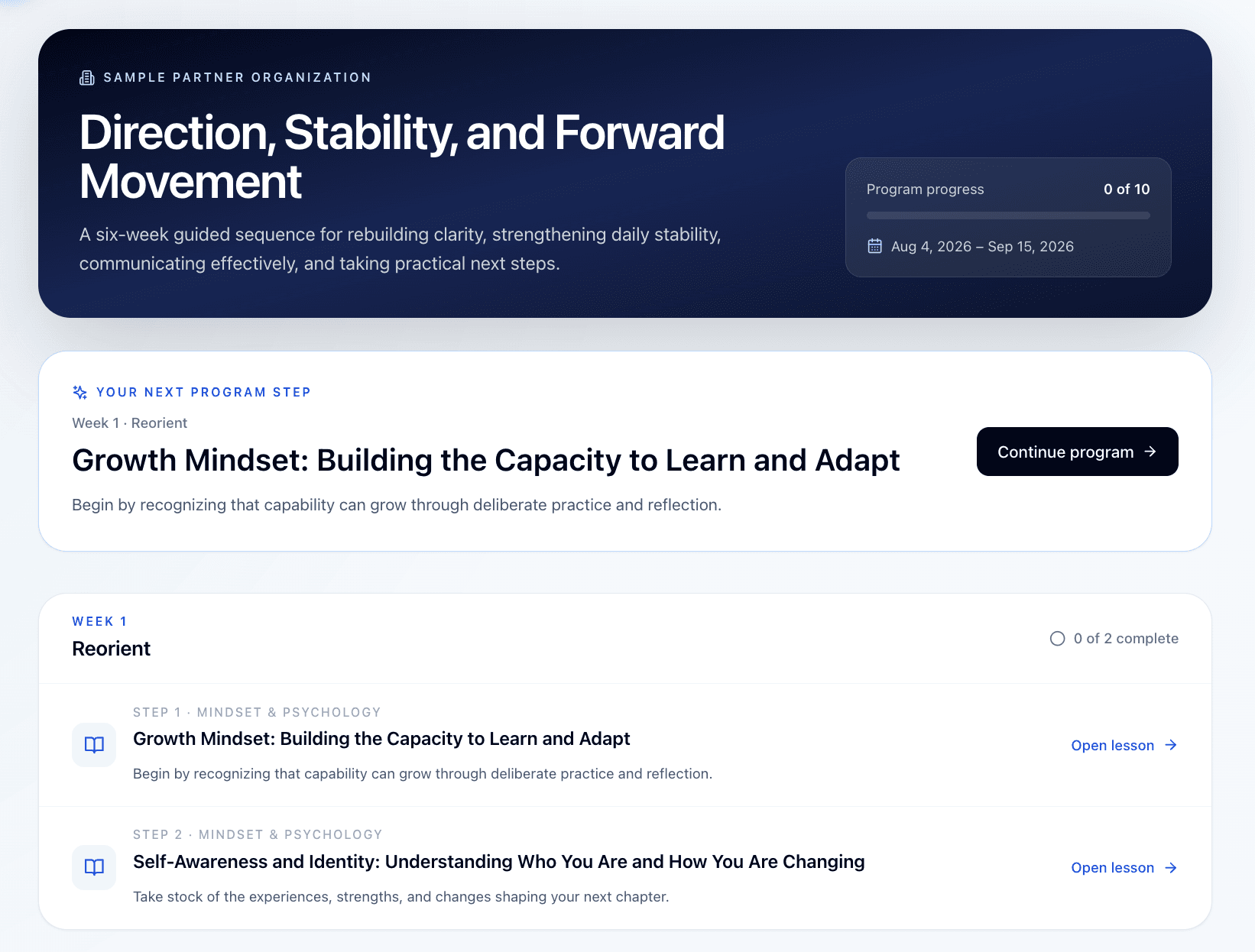
Illustrative participant view of an organization-sponsored six-week program.
What participants receive
A structured environment for continued development.
A clear next step
Every participant begins with one concrete, achievable move forward rather than an open-ended list of options.
Focused learning pathways
Structured sequences organize development so participants always know what to focus on now and what comes next.
Guided reflection
Prompts help participants connect what they are learning to their own circumstances, decisions, and next actions.
Practical application
Lessons translate into practical steps participants can apply between formal program touchpoints.
Visible progress
Completed work, activity, and momentum are made visible so effort accumulates into evidence over time.
What organizations gain
A practical extension of the work you already do.
- A structured extension of your existing programming
- Flexible pathways aligned with the needs of your participants
- A consistent environment for continued development between touchpoints
- A practical way to test fit through a defined pilot before any broader commitment
Where it can fit
Built for programs supporting people through transition.
Reentry and justice-impacted programs
Help participants hold direction and keep building capability during the stretches between case-management contact and structured programming.
Workforce development organizations
Give job seekers and trainees a way to keep advancing skills and momentum between cohorts, appointments, and placement milestones.
Behavioral health and recovery programs
Support continued reflection and steady, self-directed movement in the time between sessions and group meetings.
Youth development organizations
Offer young people a structured way to continue developing across life and work outside of scheduled program hours.
Education and community-based programs
Extend the reach of instruction and mentorship with a connected environment for continued, self-paced development.
Not sure where your program fits? A focused pilot is the clearest way to find out.
Discuss a PilotHow a pilot works
A focused pilot for a small participant group.
The organization sponsors a multi-week program; participants enter through a private invitation and do not purchase anything themselves. At the end, we review participation, completion, and feedback together to evaluate fit.
- 01
Select the participant group
Identify the cohort, transition context, and desired outcomes.
- 02
Configure the program
Choose a focused multi-week sequence across relevant development areas.
- 03
Invite participants
Participants enter through a private, organization-sponsored invitation.
- 04
Review progress and fit
Evaluate participation, completion, and feedback before any broader commitment.
Discuss a pilot.
Explore a focused implementation for a small participant group and evaluate the fit before expanding.